AI engineering · Future AGI · 2025 — now · Python · TypeScript · Java · C# · OpenTelemetry
traceAI
Open-source, OpenTelemetry-native tracing for AI apps: every LLM call, prompt, token, retrieval and agent decision recorded as a span.
What I did
I wrote traceAI’s TypeScript SDK in May 2025, and its C# and Java SDKs for v1.0.0, which I published in March 2026.
For v1 I also added 31 TypeScript and 23 Python instrumentation packages, and moved the TypeScript packages onto the OpenTelemetry gen_ai conventions the other SDKs use.
I’m listed as a maintainer on the npm packages, including @traceai/fi-semantic-conventions, the shared attribute names for the TypeScript packages.
Who I made it with
Built with the Future AGI team, including JayaSurya-27 (the second-largest contributor), sarthakFuture and nik13.
What it’s for
Normal monitoring sees an agent as one HTTP request. Inside that request the agent retrieved documents, called a model twice and picked a tool, and any of those steps can fail while the request still returns 200.
traceAI instruments the frameworks people already use, so each of those steps becomes a span in a standard OpenTelemetry trace that any OTel backend can read.
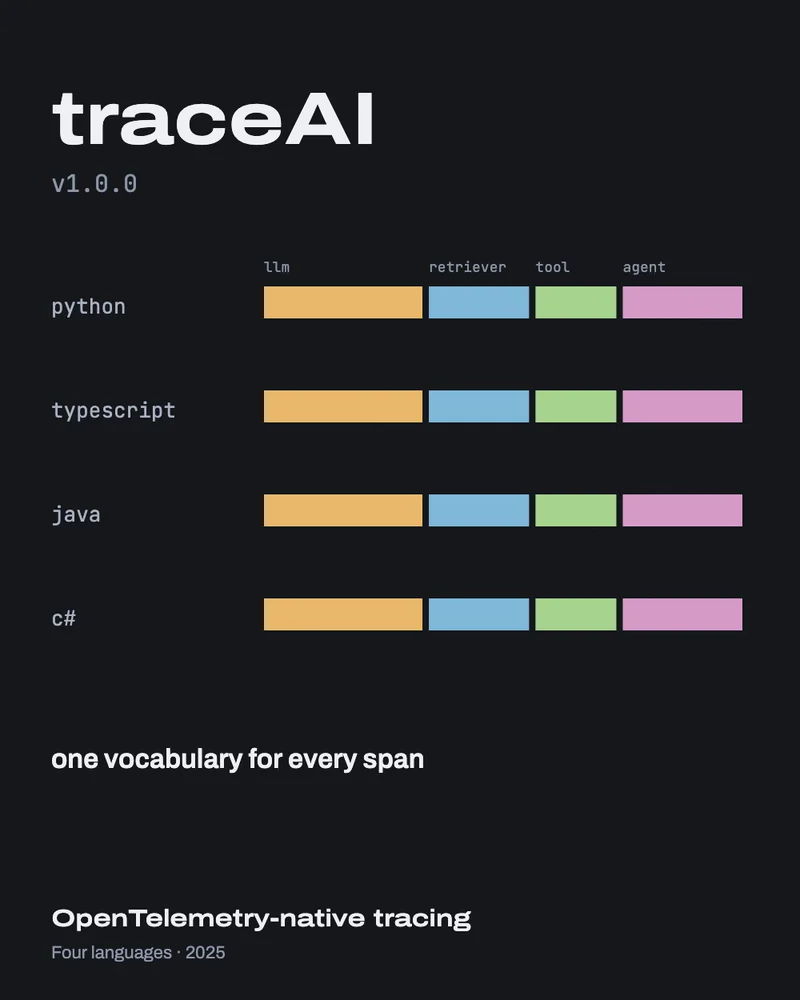
Why it was hardFour languages, dozens of frameworks, one vocabulary. A span has to mean the same thing whether it came from LangChain in Python or Spring AI in Java.
Why one standard matters
A trace is only useful if you can compare it: same step, same attribute names, across a Python service and a Java one. v1 put unified semantic conventions across all four SDKs.
What it covers
LLM providers (OpenAI, Anthropic, Vertex AI, Bedrock, Mistral, Groq and more), agent frameworks (LangChain, LlamaIndex, CrewAI, AutoGen, OpenAI Agents, Spring AI, LangChain4j), vector databases (Pinecone, Chroma, Qdrant, Weaviate, Milvus, pgvector…) and tools such as Guardrails, Instructor, MCP, Pipecat and LiveKit.
In numbers
- 4
- languages in v1.0.0. Source
- 46 / 39 / 24
- Python packages / TypeScript packages / Java modules at v1. Source
- 54
- npm packages listing me as a maintainer. Source
- 14k
- downloads last month of traceAI’s core Python package (Sep 2026). SourceProject reach, counted by PyPI Stats (which includes CI installs), not a measure of my part; what I did is above.
- 222
- GitHub stars on traceAI (Sep 2026). Source
Getting started
from fi_instrumentation import register
from fi_instrumentation.fi_types import ProjectType
from traceai_openai import OpenAIInstrumentor

trace_provider = register(
    project_type=ProjectType.OBSERVE,
    project_name="my_ai_app",
)
OpenAIInstrumentor().instrument(tracer_provider=trace_provider)More from the project
Receipts
- github.com/future-agi/traceAIWhat traceAI is, OpenTelemetry-native, integrations, Apache-2.0 license, contributor ranking.
- traceAI v1.0.0 release (published by @NVJKKartik, 11 Mar 2026)Four languages; 46 Python packages, 39 TypeScript packages, 24 Java modules, C# core SDK.
- future-agi/traceAI — Kartik’s merged PRs, including the v1 SDKs (#127–#131) and TypeScript support (#9)All authored by Kartik: C# SDK (#127, 10 of 10 commits), Java SDK (#128, 7 of 7), 31 new TypeScript packages (#129), TypeScript move to gen_ai conventions (#130), 23 new Python instrumentors (#131), merged 23–24 Feb 2026. TypeScript support (#9, merged 20 May 2025): FITracer, register, OpenAI, Anthropic and LangChain instrumentation, 28 of 32 commits (sarthakFuture 4). The v1.0.0 notes say TypeScript grew from 8 packages to 39.
- traceAI contributors graphKartik is the top contributor: 215 commits, then JayaSurya-27 (145) and sarthakFuture (29), on 26 Sep 2026.
- npm — ~nvjkkartikListed as a maintainer on 54 packages (@traceai/*, @future-agi/*, @agentcc/*) on 2026-09-25.
- PyPI Stats — fi-instrumentation-oteltraceAI’s core Python instrumentation package: 14,383 downloads in the month to 26 Sep 2026 (traceai-openai: 11,864).
- GitHub — future-agi/traceAI222 stars and 44 forks on 26 Sep 2026.
 Next, a little further back in timeSpeaker diarization in classrooms →