Peer-reviewed paper · IIT Bombay · IEEE TALE 2024
Speaker diarization in classrooms
Best Student Paper
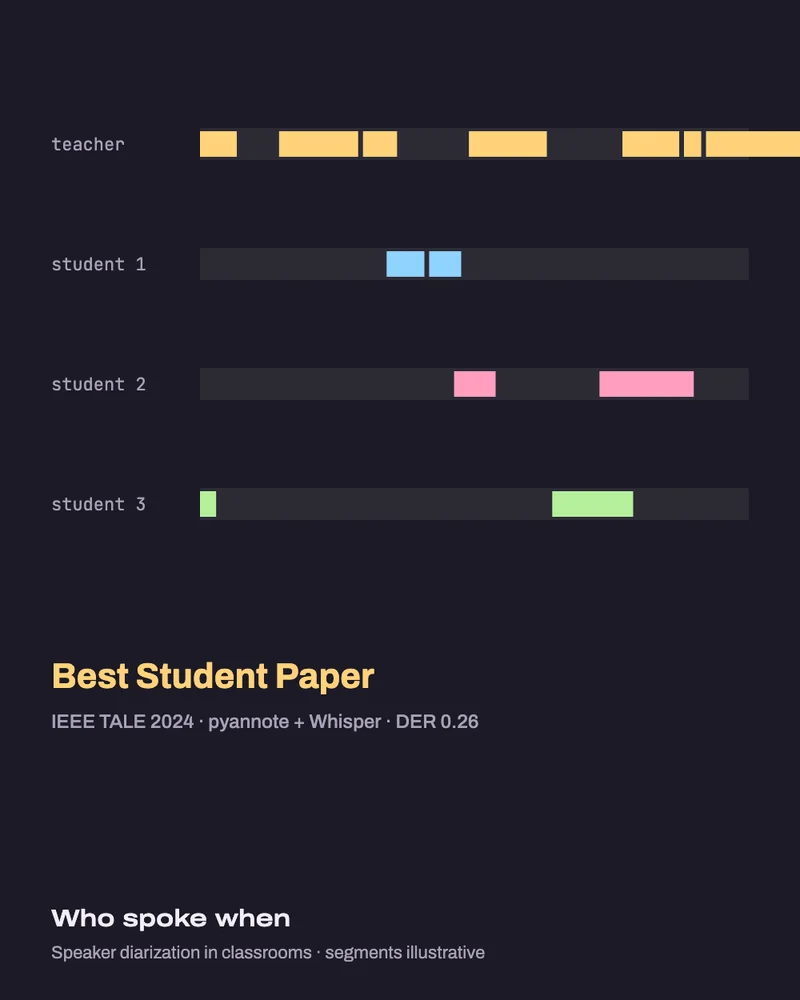
Who said what, in a classroom where people switch between English and local languages mid-sentence?
What I did
Co-author, second of seven. My part was the diarization pipeline work.
I implemented speaker diarization for code-switched classroom audio, with pyannote and Whisper.
Authors
Aarsh Desai, N.V.J.K Kartik, Priyesh Gupta, Vinayak, Ashwin T S, Manjunath K. Vanahalli, Ramkumar Rajendran
The call I made
Don’t trust one system with mixed-language speech
Off-the-shelf diarization struggles when a class moves between English and local languages mid-sentence. Combine a diarizer with Whisper’s transcription, a custom voice-activity detector and a clustering step, and measure it against the commercial options.
- Classroom audioEnglish and local languages, mid-sentence
- Custom voice-activity detection
- pyannote diarization + Whisper transcription
- Embedding clusteringwho is who
- DER 0.26the lowest of the systems compared
Full title
Advancing Speaker Diarization With Whisper Speech Recognition for Different Learning Environments
In plain words
Speaker diarization splits a recording by speaker: this stretch is the teacher, this one is student two. It is the first step before you can study how a class actually talks.
Off-the-shelf systems struggle with Indian classrooms, where speech moves between English and local languages. The paper tests whether a combined pipeline does better.
How it works
- The pipeline combines pyannote.audio diarization with OpenAI Whisper transcription, a custom voice-activity detector, and an embedding-clustering step.
- Evaluation used 137 recordings from an online HCI course and an augmented-reality classroom.
What it established
- The pyannote + Whisper pipeline had the lowest Diarization Error Rate of the systems compared (DER 0.26), ahead of commercial options including Deepgram and Otter.
- It won the Best Student Paper award at IEEE TALE 2024.
Where it stops
- A DER of 0.26 still means roughly a quarter of speaking time is attributed to the wrong speaker, or missed. Better than the alternatives is not the same as solved.
- Two learning settings. How well it transfers to other classrooms and languages is open.
Receipts
- IEEE Xplore — Advancing Speaker Diarization With Whisper… (TALE 2024)Method (pyannote + Whisper, custom VAD, embedding clustering), 137 recordings, DER 0.26 vs Deepgram/Otter.
- IEEE TALE 2024 — AwardsBest Student Paper; full author order (Aarsh Desai first, Kartik second).
- IIT Bombay Educational Technology — AwardsIndependent listing of the TALE 2024 Best Student Paper.
- Previous portfolio, as it stood before this redesign (self-reported)Self-reported: IIIT Dharwad (Data Science & AI), research at IIT Bombay Educational Technology, CRF approach for SSMR.
 Next, a little further back in timeMarket sentiment →