Platform engineering · Future AGI · 2026 · Django · ClickHouse · Postgres
Annotations on ClickHouse
Moving the annotation system’s reads onto ClickHouse ahead of the Postgres tracer tables being dropped, and keeping it standing: 20 merged PRs over July 2026.
What I did
I was responsible for the annotation side of the migration. Over four weeks that was 20 merged PRs, 16 on annotations and 4 on Error Feed and its scanner: every annotation read path moved to ClickHouse (resolution, previews, availability checks, scores, export, and the filter-mode adds), Error Feed moved too, memory guardrails so ClickHouse reads stopped running out of memory on large voice spans and in the trace scanner, project scoping on every queue read, and a performance sweep of the queue screens that removed N+1 queries, per-row reads and per-item writes.
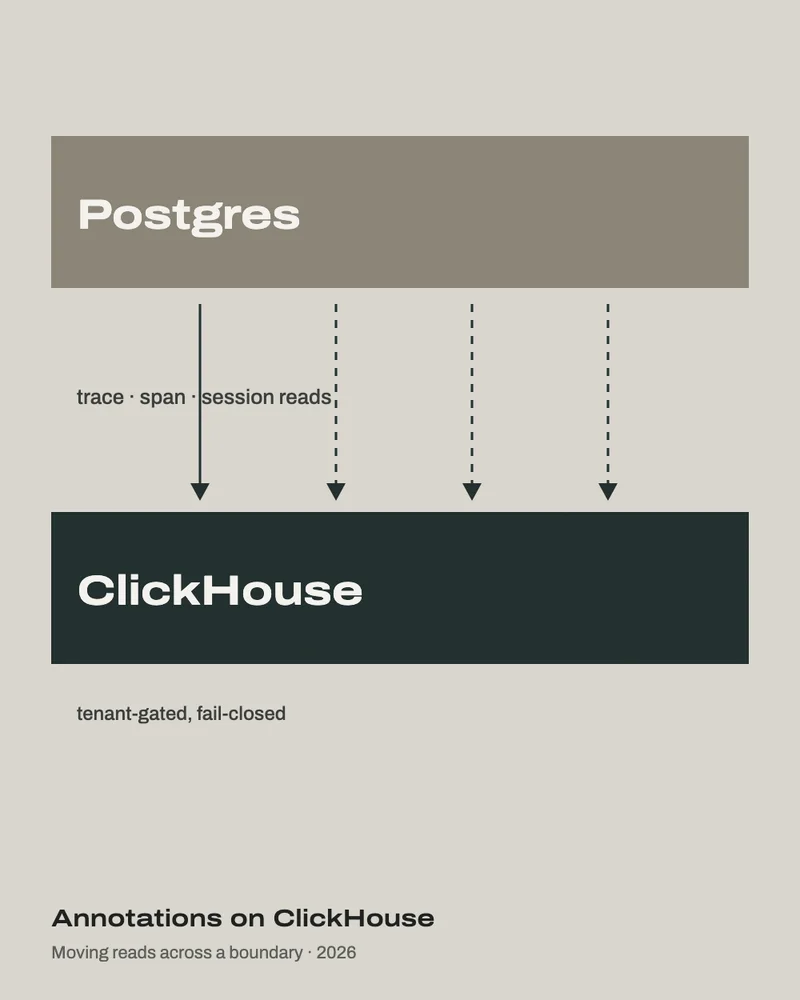
The core PR moved the subsystem’s reads of trace, span and session data to ClickHouse. Reads are tenant-gated and fail closed.
Trace roots are read in lean batches so large queues don’t run out of memory. The PR replaced my own earlier draft, which only guarded the Postgres reads, since removing them was the right end state once the tables were gone.
Who I made it with
One part of the team’s wider migration of tracing to ClickHouse.
The call I made
Remove the old path, don’t guard it
The Postgres tracer tables were being dropped. My first draft guarded every read against the table going missing; the right end state was to stop reading them at all, and to fail closed rather than open.
- Annotation readresolve, preview, score
- Postgres tracer tablesbeing dropped
- Catch the missing tablea savepoint and a 42P01 catch
- A guard around a table that won’t exist
- Annotation readresolve, preview, score
- Straight to ClickHouselean, batched reads
- Checked against the tenantfails closed
- Large queues stay in memorytrace roots read in batches
What it’s for
Tracing at Future AGI was moving fully to ClickHouse, and the Postgres trace, span and session tables were going away. The annotation system (queues, scores, span notes) still read trace data from Postgres.
Why it was hardRemoving a data source from under a live feature. Every read path had to move without leaking data between tenants or failing open.
In numbers
Receipts
- future-agi/future-agi PR #1495 — ClickHouse-native reads for annotation sources (merged 11 Jul 2026)Annotation reads of trace, span and session data moved to ClickHouse; tenant-gated, fail-closed; lean batched reads; supersedes the drop-safety draft #1214, which guarded the Postgres reads instead of removing them. 575 annotation tests passing across 12 suites. Authored by Kartik.
- future-agi/future-agi — Kartik’s merged annotation and ClickHouse PRs20 merged PRs, 3–31 Jul 2026: 16 on annotations, 4 on Error Feed and its scanner. Annotation reads to ClickHouse: #1427, #1495, #1604, #1607. Error Feed: #1510, #1644. Memory: #1160, #1434 (annotations), #1373, #1455 (trace scanner). Project scoping: #1565. Queue performance: #1591, #1593, #1831, #1852, #1861, #1865, #1871, #1876, #1878. The link lists all of Kartik’s merged PRs in the repository, not only these 20.
 Next, a little further back in timeError Feed →