Book chapter · IIT Bombay · Published online 23 Oct 2025 · T4E 2024 · Springer Lecture Notes in Educational Technology
Triggers of shared regulation
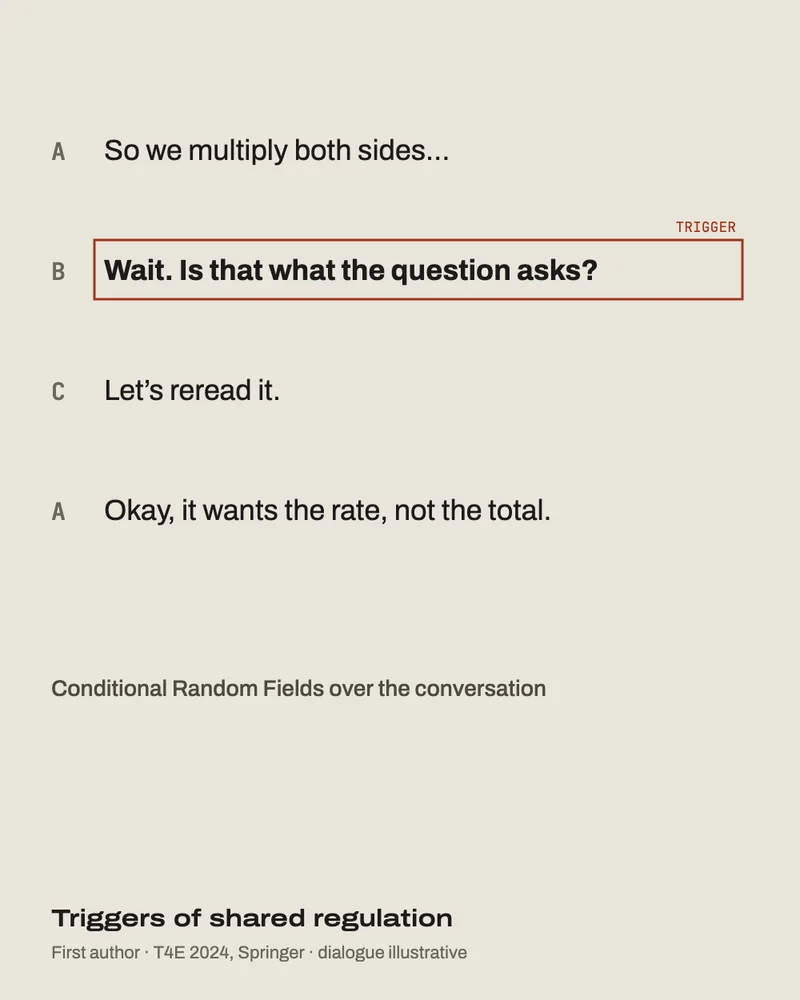
When a group stops and asks “wait, is this working?”, what set it off? Could a model spot that moment in the conversation?
What I did
First author, with seven co-authors from the same research group.
I applied Conditional Random Fields to detect the triggers of socially shared regulation in group problem-solving.
Authors
N.V.J.K Kartik, Priyesh Gupta, Vinayak, Aarsh Desai, Vishwas Badhe, T S Ashwin, Manjunath Vanahalli, Ramkumar Rajendran
Full title
Unlocking the Triggers: Automating the Identification of Triggers of Socially Shared Metacognitive Regulation in Collaborative Problem-Solving
In plain words
Socially shared metacognitive regulation (SSMR) is a group jointly checking and steering its own thinking. “Hold on, are we even solving the right problem?” is a small example.
Researchers usually find these moments by hand-coding transcripts, which is slow. This paper works on detecting what triggers them automatically, from the group’s conversation.
How it works
- The approach treats the conversation as a sequence and labels trigger moments. It uses Conditional Random Fields over collaborative problem-solving discourse.
- Published in the T4E 2024 proceedings (Vol. 2), pp. 43–51.
What it established
- It frames trigger detection as an automatable sequence-labelling task, a step toward analysing collaboration at a scale hand-coding can’t reach.
Where it stops
- It works from what people said. Tone, posture and gaze are not in the model. Later work from the group proposes a multimodal extension.
- I haven’t reproduced the paper’s headline numbers here. Read the chapter for them.
Receipts
- Springer — T4E 2024 Proceedings Vol. 2, pp. 43–51Title, author order (Kartik first), series, pages, published online 23 Oct 2025 (via Crossref metadata).
- Crossref metadata for DOI 10.1007/978-981-95-1734-3_6Author list, online publication date, page range.
- Previous portfolio, as it stood before this redesign (self-reported)Self-reported: IIIT Dharwad (Data Science & AI), research at IIT Bombay Educational Technology, CRF approach for SSMR.
- Badhe & Rajendran — multimodal follow-up on SSMR triggers (Springer, 2026)The group later proposed extending verbal-only trigger detection with video (posture, head movement).
 Next, a little further back in timeAgentCompass →